


.png)
No, you don't need to hire a 20-person team to run a serious OnlyFans account. Some solo creators manage six-figure months with the right setup and one or two trusted people helping out. But you do need to understand what "management" actually covers, because the term gets used loosely across the industry, and knowing what's included changes who you hire, what you pay, and what you should expect back.
What OnlyFans Management Actually Means
OnlyFans management is the ongoing work of running a creator's account as a business: chatting with fans, promoting on other platforms, keeping the account itself optimized, and protecting the content from being stolen or leaked. Some creators handle all of it themselves. Others hire an assistant for the parts that eat the most time. Larger operations hand the whole thing to an agency that runs it like a sales floor.
The confusion usually starts here: "management" can mean a single virtual assistant scheduling posts for $200 a month, or it can mean a full agency taking 30% of gross revenue and running a 12-person chat team. Both call themselves OnlyFans management. Only one of them is going to move your numbers.
The Core Services Every Management Operation Runs
Whether it's a solo creator with one assistant or an agency with a full floor of chatters, the same four categories of work show up every time. The difference is scale and who's doing it.
Chatting and Fan Interaction
This is where the money actually gets made. Direct messages are where PPV content gets sold, where fans get upsold to higher tiers, and where a casual subscriber turns into a high-value repeat customer who spends hundreds a month. High-performing accounts often aim for broad coverage across different hours, since fans purchase on their own schedule, often late at night or during a lunch break, and a slow reply can reduce the chance of converting interested fans into buyers.
Here's the catch: coverage without quality is just noise. A chat team answering fast but sending generic, copy-paste replies will convert worse than a smaller team that actually reads what a fan wrote and responds like a person. Volume matters, but only once the conversation quality is there to back it up.
Social Media Funneling
An OnlyFans account doesn't grow on its own. The traffic usually comes from X, Instagram, TikTok, Reddit, and more, where a creator or agency posts free previews, teasers, and calls to action that push followers toward the paid page. This is often the most visible part of management from the outside, since it's the content people actually see before they ever subscribe.
Good funneling isn't just posting more. It's matching the platform: what works as a TikTok hook falls flat as an X caption, and vice versa. Agencies that manage multiple creators usually build a repeatable posting cadence per platform rather than improvising content day to day.
Account Optimization
This is the quieter, more operational side: scheduling posts so the feed stays active, structuring subscription tiers so fans have a clear reason to upgrade, and tracking which content and price points actually perform. It's less glamorous than chatting or social growth, but it's the layer that turns a good month into a repeatable one.
So, how do you know if your account is optimized? Look at whether your tiers are actually being used. If every subscriber sits on the base tier and nobody upgrades, the pricing structure isn't doing its job, no matter how good the chatting is underneath it. The same logic applies at the PPV level: charging every fan the same price for the same content ignores what each fan has actually shown they're willing to pay, which is money left on the table.
Content Protection
Leaked content is a real cost, not just an annoyance. Watermarking, monitoring for leaks across piracy sites and Telegram groups, and having a takedown process in place protects revenue that would otherwise get siphoned off by people never paying a cent. Bigger agencies build this into their standard service. Solo creators often skip it until the first leak happens, which is the wrong order to learn the lesson in. Knowing the actual steps to take once content gets stolen, from documenting it to filing a takedown, saves a lot of panic later.
How Top Solo Creators Run Their Own Accounts
Independent creators making real money rarely do everything by hand. Most build a lean system: one or two trusted people helping with chat during off hours, a content calendar planned a week or two out, and some kind of tool tracking which fans are spending and which have gone quiet. The creator stays the face and voice of the account, but the operational load gets split.
The biggest mistake solo creators make is treating every fan the same. A subscriber who's spent $12 total and one who's spent $600 need completely different attention. Top earners build a rough system for spotting their high spenders, whether that's manual notes or an actual fan CRM, so their limited time goes toward the relationships that pay. For the specific inbox habits and content systems that make this work day to day, this breakdown of how organized creators run their accounts covers it in more detail than fits here.
Remember that balance matters here. Chatting all day without sleep isn't sustainable, and it isn't necessary either. The goal isn't more hours in the inbox. It's making the hours you do spend count more, which is exactly where an AI chatter that handles first replies and low spenders has started changing what "solo" management looks like.
How Top Agencies Run Their Accounts
Agencies operate more like a sales floor than a creative studio. A typical structure splits creators across a small team of chatters, with a manager overseeing volume, tone, and conversion rates across the roster. The best agencies build tiers into how they staff: junior chatters handle lower-spend, high-volume conversations, while senior chatters or the creator themselves step in for VIP fans and custom requests.
Access is a real operational concern here, not an afterthought. Handing out an OnlyFans password to ten different chatters is a security risk waiting to happen. Agencies that run this well use platforms with role-based access, allowing each chatter to have their own secure login instead of sharing a single password, which improves accountability when issues arise in a conversation.
Performance tracking is what separates agencies that scale from ones that plateau. Messages per hour, revenue per chatter, and conversion rate by shift are the numbers that tell a manager whether someone needs coaching or whether an account itself has a pricing problem. That's a coaching problem, not a hiring one, more often than agency owners assume when a chatter's numbers dip. For a deeper look at setting up role-based access and chatter benchmarks, it's worth reading as its own guide.
Matching Management to Where You Actually Are
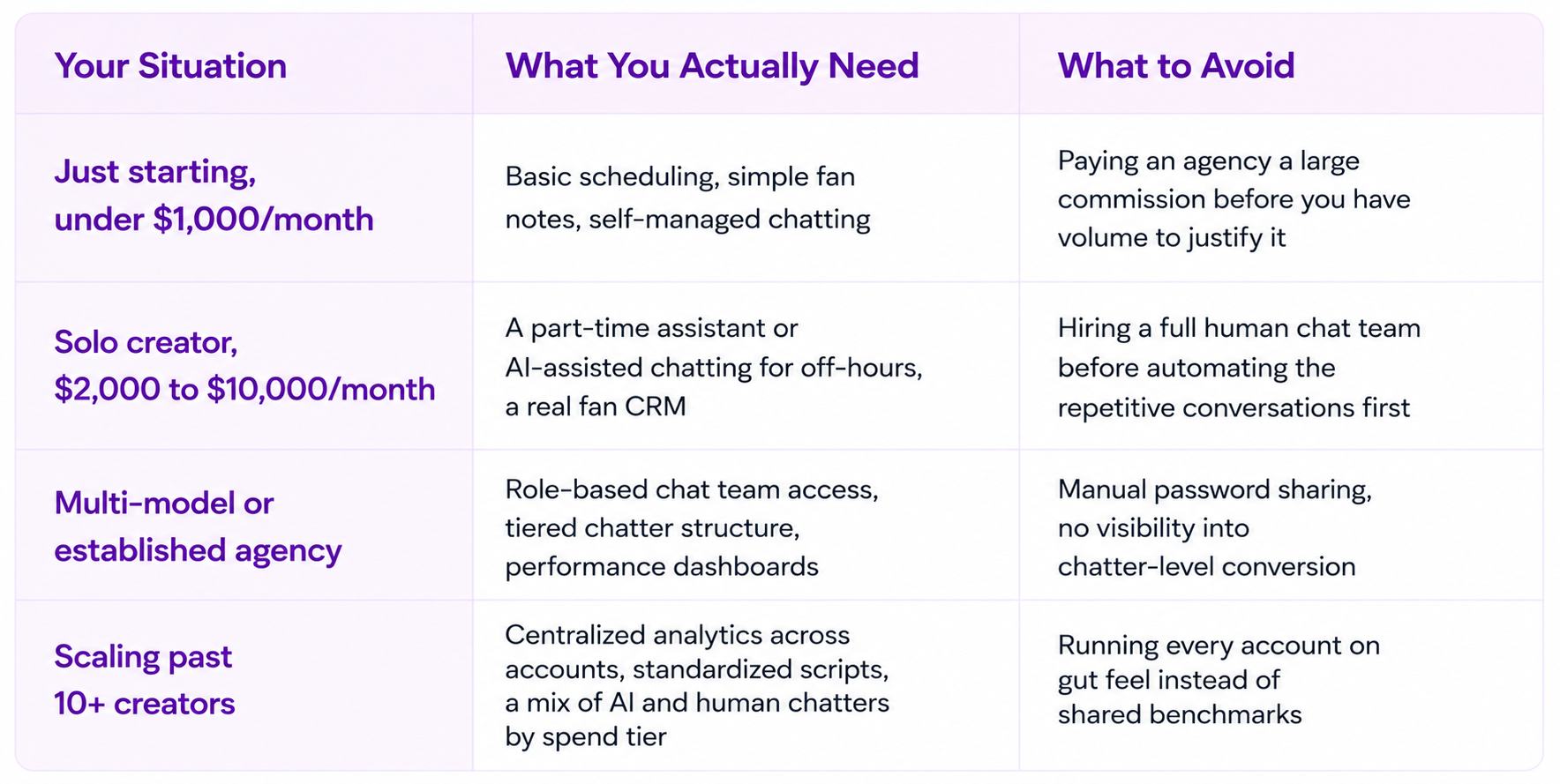
Not every creator needs the same setup, and buying more management than your account can support just eats margin. Here's a plain breakdown of what typically fits at each stage:
Compensation and Terms: What Management Actually Costs
Commission structures vary widely across the industry, and this is the part where creators most often get burned, either by paying too much for too little or by trusting numbers an agency can't actually back up. Broadly, agency commissions run from around 10% to 50% of gross revenue depending on how much of the work the agency takes on. A lower commission usually means the creator is still handling socials and content themselves, while a higher one usually includes full-service chatting, funneling, and account management combined.
Here's the part worth being blunt about: any agency or tool quoting you a specific revenue lift, like "we'll take you from $15,000 to $30,000 a month," should be able to show you where that number came from. Vague promises with no data behind them are a red flag, not a selling point. Ask what the number is based on, whether it's from a comparable account, and what happens if results land below it.
The same honesty applies to platforms and software. AI chatting tools and CRMs typically charge either a flat monthly fee, a per-message cost, a commission on AI-generated sales, or some combination of the three. Don't accept a pricing model you can't reconstruct with your own numbers. If a platform can't clearly explain what a typical month would cost you at your current volume, that's worth a second look before you commit. Supercreator's own plans and per-message costs are published for exactly this reason, so you can run the math yourself before signing up for anything.
Vetting an Agency Before You Sign
A few questions cut through most of the noise when you're evaluating a management agency. Ask how many creators each chatter handles, since an overloaded chatter means slower replies and generic conversations regardless of what the sales pitch says. Ask whether they can show anonymized performance data from existing accounts, not just testimonials, since testimonials are easy to write and hard to verify. And ask directly what happens to your account access if you decide to leave, since password-sharing arrangements can turn an exit into a security problem. If you're comparing agencies rather than building an in-house team, the OnlyFans agency directory is a reasonable place to start narrowing options.
Where Automation Fits Into Modern OnlyFans Management
The management model has shifted in the last couple of years, and the shift is mostly about coverage. Human chatters still handle the relationships that matter most, but more agencies and creators are beginning to incorporate AI chat assistants alongside human chatters to cover the volume a small team physically can't. Supercreator's Izzy AI can provide 24/7 coverage (when configured to do so) without gaps, and it handles qualifying conversations and lower-spend fans, so the humans on the team can focus on VIPs and custom requests instead of burning hours on small talk.
That same shift is why role-based access, chatter performance tracking, and a real fan CRM aren't optional anymore for anyone managing more than one or two accounts. Guessing which chatter is underperforming, or which fan tier is worth the most attention, is the kind of gap that live analytics on chatter activity and revenue close fast once you have them in place.
Signs You Need Management
Some signs are easy to miss because they show up gradually, not all at once. If two or three of these are true at once, that's usually the point where an account has outgrown doing everything solo.
- Your inbox is unmanageable. You're opening OnlyFans to hundreds of unread messages instead of a handful. That's not "busy"; that's structurally behind, and no amount of late nights fixes it on its own.
- Response times are slipping. Fans are waiting for hours instead of minutes for a reply, especially those actively trying to buy something. A fan ready to spend right now usually isn't still ready three hours from now.
- Posting has gotten inconsistent. A content calendar that used to be reliable now has gaps, or posts go out whenever there's time instead of on a schedule. Fans notice the silence before it shows up as a number you can point to.
- You can't track your top spenders anymore. Once you have more than a handful of regulars, keeping their spend history in your head stops working. If you can't name your five biggest spenders this month off the top of your head, you're probably treating a $500 fan the same as a $15 one.
- You're seriously considering your first chatter. This is usually the clearest signal. Before taking on the cost and overhead of a human hire, it's worth asking whether an AI assistant, like Supercreator, covering first replies and lower-spend fans could close that gap first.
Turning Management Into a System, Not a Guessing Game
Whether you're running your own account or managing a roster of ten, the operators who win aren't working harder than everyone else. They're running a system: clean chat coverage, secure team access, real performance numbers, and automation covering the volume a person alone can't. Supercreator brings those pieces together in one platform, from Izzy handling first replies and low-spend fans to role-based access that lets a chat team work without ever sharing a password, backed by analytics that show exactly where your revenue is coming from.
If you're managing your own account and want to see what AI-assisted chatting and a real fan CRM can do for your time, start free with Supercreator and connect your account in minutes. If you're running an agency and want to see how role-based access, chatter benchmarks, and Izzy work together across a full roster, book a demo and we'll walk you through it on your own numbers.





.png)

