We talked with Luis, CEO of Artivate, who shared insights from his experience. Artivate is a recruitment agency that places chatters, marketing talent, and C-level hires for OnlyFans agencies such as Rose Agency, FEM Management, and KOAS.
Start With a One-Page Role Brief
Before posting a job, write down exactly what the role is. Luis keeps it short: "A good role brief is short, ideally under one page, because the more you write, the more people skim past it."
Every good brief covers the same five things:
- Scope of work: what the person will actually do day-to-day.
- Setup: the team and support around the role: who the person reports to and who helps them.
- Pay: the base salary and exactly how the commission works. "A lot of agencies just write 'bonuses available', and candidates know those bonuses often never come."
- Requirements: only measurable hard facts like experience, skills, and language level. "Anyone can call themselves 'hungry' or an 'A-player', so words like that don't help you filter candidates. If you need a certain mindset, show it through how the work actually runs."
- Working hours: how many hours and roughly at what times. "If you expect people to be reachable outside their shift, say so now."
According to Luis, the most common mistake is skipping this step altogether: "The biggest one is not knowing exactly who they're looking for, and most of the other mistakes come from that."
A typical example is posting for a "marketing manager" when what the business really needs is someone to research and write scripts for Reels. "A real manager will be underchallenged in that job and won't stay for long."
Two more mistakes to avoid: not checking what a realistic salary for the role is, and hiring chatters at the wrong level. "If you put a top chatter on a low-traffic account with little revenue potential, they'll be underchallenged and probably won't stay long."
Choosing Where to Hire Chatters
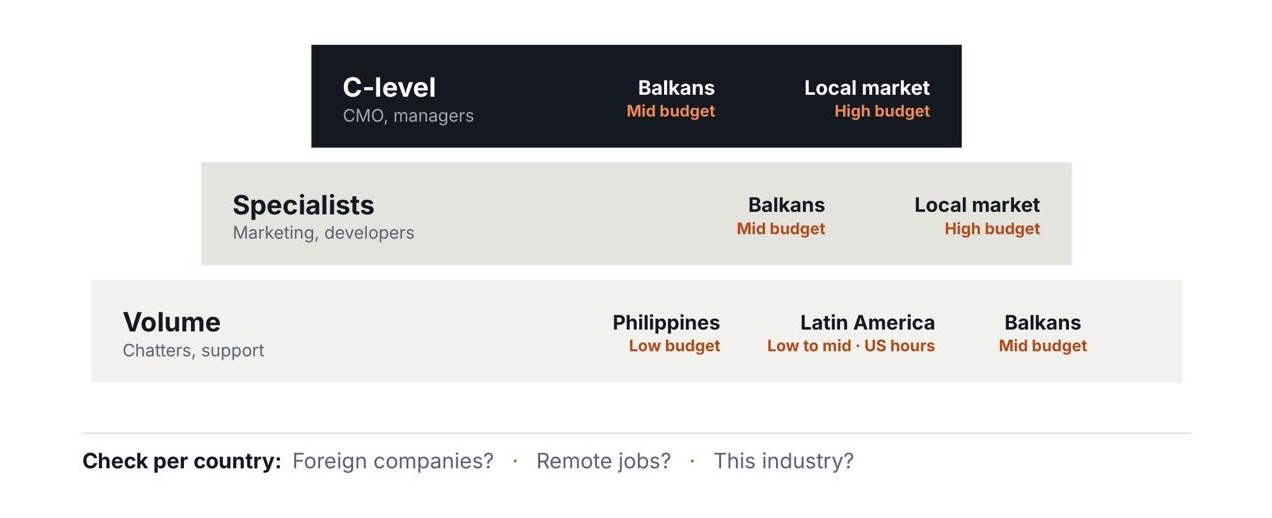
The Philippines, Latin America, and the Balkans are all common hiring markets for chatters. Which one fits "really depends on what the agency needs," and the clearest difference is cost. "Chatters from the Balkans and some Latin American countries ask for more money, and in our experience they also often deliver more per person."
Because each chatter costs less, the Philippines makes it easier to scale a large team. Still, both regions can work for big volume teams as well as for smaller teams that focus on top spenders.
English level is not the deciding factor. "You set a minimum, and every candidate has to meet it, wherever they're from."
Time zone matters more, but it shouldn't rule anyone out. "For US agencies, Latin America can be worth a look."
Before you commit to a country, check three things: whether people there already work for foreign companies, whether remote jobs are common, and whether they are open to working in this industry.
How AI Is Changing Who Agencies Need to Hire
How much of the chatting to hand over to AI is becoming one of the biggest hiring decisions creators and agencies make. As AI chatters such as Supercreator's Izzy take over routine conversations, the human role shifts. Chatters spend less time answering the same opening messages and more time where judgment matters most: high-value fans, conversations the AI escalates, and long-term relationships with the fans who drive most of the revenue.
That changes what to look for in a candidate:
- Relationship management: the ability to keep a high spender engaged over months.
- Judgment on escalations: stepping into a conversation the AI has handed over and responding in the creator's voice.
- Sales skill at the top end: experience with big spenders counts for more than speed.
- Working alongside AI: reviewing what the AI sends, spotting where it needs better instructions, and knowing when to take over.
In practice, this usually means hiring fewer, more experienced chatters and adding escalation scenarios to the written assessment below.
Luis sees the same shift. The skills that matter most in the chatters he places are “emotional intelligence, the ability to stay in character, and thinking long term so you can build lasting relationships with fans. These have always mattered, but with AI taking over the routine conversations, they’re now the core of the job.”
Artivate hasn’t changed how it screens for them. “These are exactly the skills that already matter in volume chatting, and we’ve always put a lot of weight on them in our screening, since they’re what separates a good chatter from an average one. AI just makes them even more important.”
Agencies aren’t asking for new roles either, but the existing ones are changing. A chatting manager is now expected to work with AI chatting, ideally with hands-on experience, and marketers are expected to know AI content creation. “It’s less about new roles appearing and more about AI becoming part of the everyday work in the roles that already exist.”
Pay hasn’t shifted across the board, but AI-assisted agencies want really strong chatters for the human roles they keep, “and those chatters can ask for more.” Most of the money still comes from high spenders, and in most agencies people still handle those conversations. “So for a good chatter, this setup can mean very high commissions.”
The biggest mistake Luis sees agencies make with AI is prioritizing short-term revenue over long-term fan relationships: “Many AI setups can make a lot of money quickly but hurt the relationship with fans in the long run.” Agencies need chatting managers who review AI chats and adjust them to each model’s tone and branding. “Agencies that move to AI without hiring for this role often lose quality without noticing.”
What to Pay Chatters, Marketers and Marketing Leaders
Pay mostly depends on experience and skill. "Someone who already earned well at another agency won't go back down, and in the end you're paying for the value a person brings."
For chatters, Luis talks about total monthly earnings rather than commission rates. "A percentage only means something next to the revenue the agency gives the chatter to work with. 3% can be a lot and 10% can be very little."
Here are the monthly, full-time ranges he sees today. All of them depend a lot on experience, especially for chatters and heads of marketing:
- Chatters (Philippines): at least $500 to $1,000 a month in total.
- Chatters (Balkans): $600–700 at the low end, $1,000+ for good people with other options, and $3,000–4,000/month for top performers at big agencies.
- Marketing managers (Balkans or Western countries): $1,500+/month in the Balkans for real expertise, and $2,500–3,000+ in Western countries, “since you’re competing with other industries.”
- Head of marketing: at least $2,000 a month in the Balkans, and more as the business and the responsibility grow. "Big agencies often pay their leadership $5,000 to $10,000 a month."
Where to Find Candidates for Each Role
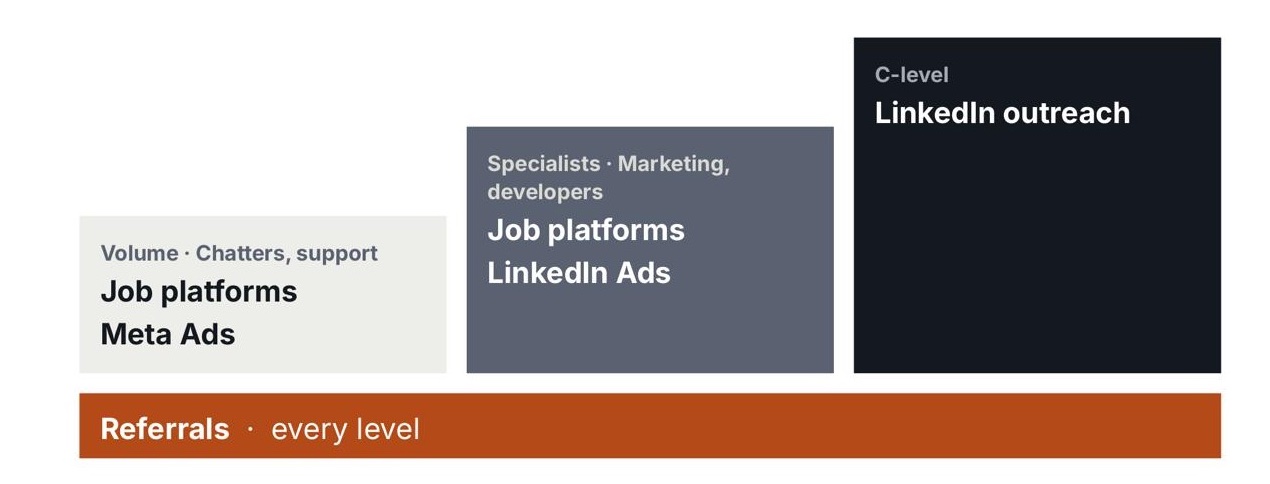
The best channel "depends on the role and the country." Referrals work at every level. Beyond that, the level decides the channel:
- Chatters: "Job platforms work best, and Meta Ads work too if you run them properly."
- Specialists (marketing, developers): job platforms and LinkedIn Ads. "LinkedIn job posts are underrated, especially for more advanced roles that exist in other industries too."
- C-level roles: "LinkedIn outreach is the way to go."
OnlyFans experience itself matters less than the skills behind it, wherever a candidate comes from. "OnlyFans job boards are a fine place to start, but a lot of strong candidates come from sales, marketing, or iGaming and bring skills that transfer really well. If you only use niche boards, you never see them."
iGaming is a particularly strong source for marketing and C-level hires. "In most industries, a customer is just a customer, but in iGaming, just like here, high spenders bring in a huge share of the revenue, and people from that world know how to attract them and treat them differently."
Artivate filled head of marketing roles this year mostly with people from iGaming, including a placement with Echelon. "It's worked very well; the feedback has been consistently good, and they've stayed. That senior level is where their experience pays off most."
For specialist roles, other backgrounds often fit better: "people with a lot of hands-on experience in organic content like Reels, people from other parts of the adult industry, and people from influencer marketing who find and book influencers for brands like e-commerce stores."
Writing Clear, Policy-Compliant Job Ads
Job platforms and ad networks each set their own rules for adult-industry listings, and many restrict them. Before posting, read the policies of every platform you plan to use and only post where your listing is allowed.
Within those rules, describe the role with an accurate title that reflects the actual work. Many roles in this industry match standard job titles because the work itself transfers: "Chatters are salespeople at the end of the day, and marketing or C-level roles look almost the same in other industries." Clear, familiar terms also widen the pool: "many people who would make great chatters don't know this industry yet and don't realize their sales experience could earn them good commission here."
Disclose the industry early and plainly, in the ad itself where the platform allows it, and at the latest at the very first step of the application, for example with a question in the application form. "That way, anyone who isn't comfortable with it drops out before you've spent time on an interview. It's important to handle this part professionally and discreetly."
Outreach for Senior Hires
For senior roles, Artivate reaches out to candidates directly. "If you already do a lot of outreach by email, something like Juicebox works well. We use it to pull matching profiles and contact details and then reach out ourselves. Some tools send messages directly on LinkedIn."
The first message stays simple. "We say how we found the person and how we got their email or number, introduce ourselves, outline the job and what it pays, and ask if they're interested. If they are, we send the full job offer and ask for a CV."
The approach works: in Artivate's email campaigns over the past few months, mostly for organic marketing experts, the outreach reached a 92% open rate and a 31% reply rate across roughly 5,000 contacts.
Screening: A Fast Intake and a Scored Assessment
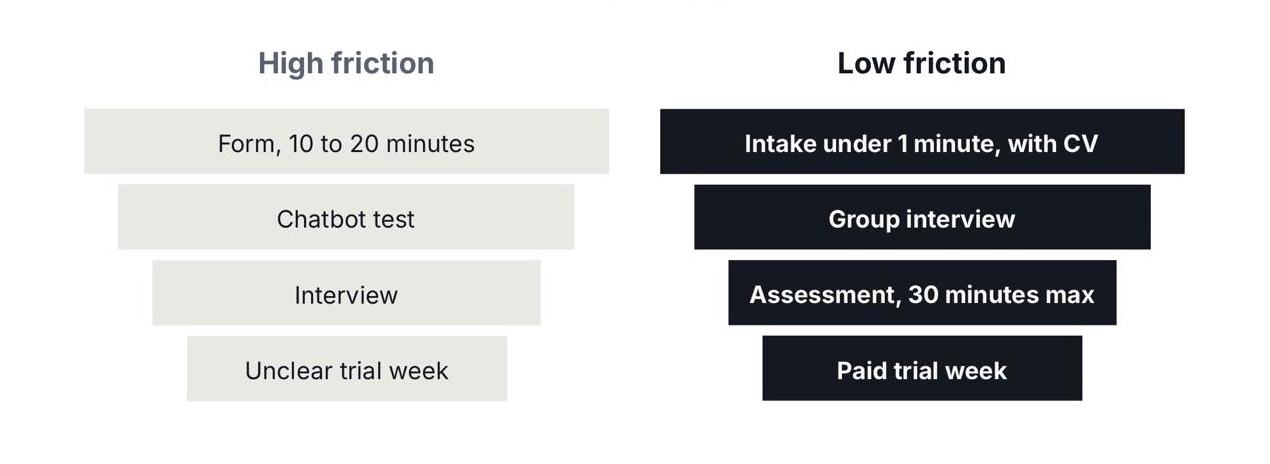
For volume roles, Artivate replaces long application forms with an intake that takes under a minute. "The intake isn't where you qualify people properly. It just tells you whether someone roughly fits, and the real testing comes after."
The intake asks for a CV and one short question about chatting experience, "because many people leave that off their CV." From there, Luis checks whether the background makes sense. "We don't take people without any relevant experience, but every agency has to decide that for itself. We also look for red flags, like someone who switches agencies every month."
After the intake comes a group interview, then an assessment that takes 30 minutes at most. Artivate doesn't use chatbot tests. "To compare candidates fairly, everyone has to get the same questions, and a chatbot conversation can go in so many directions that it's hard to score two people the same way."
Instead, candidates get written scenarios that come up a lot in real chatting and explain how they'd handle them. "Anti-cheat software matters a lot here, so no AI, no outside help, and camera on."
Answers are rated with a fixed scoring system, because otherwise "you judge the same answer differently depending on your day and your energy. We score things like sales skills, empathy, and emotional intelligence, but each agency should decide what matters most to them."
Paid Trials, Test Tasks and Hiring Speed
A paid trial week should look as much like the real job as possible: "let the person do exactly the work they'd do later. Get the people they'd work with involved, so you see whether they get along."
Luis recommends paying the normal rate, "although for very well-paid roles a bit less can be fine."
To judge the trial, go back to what you defined before hiring. "Does the person really know what they said they know? Can they solve the problems they'll face? When you decide, trust your gut a bit, but be honest with yourself. If the next months went exactly like this week, would you be happy? If the answer is 'not sure', don't hire.”
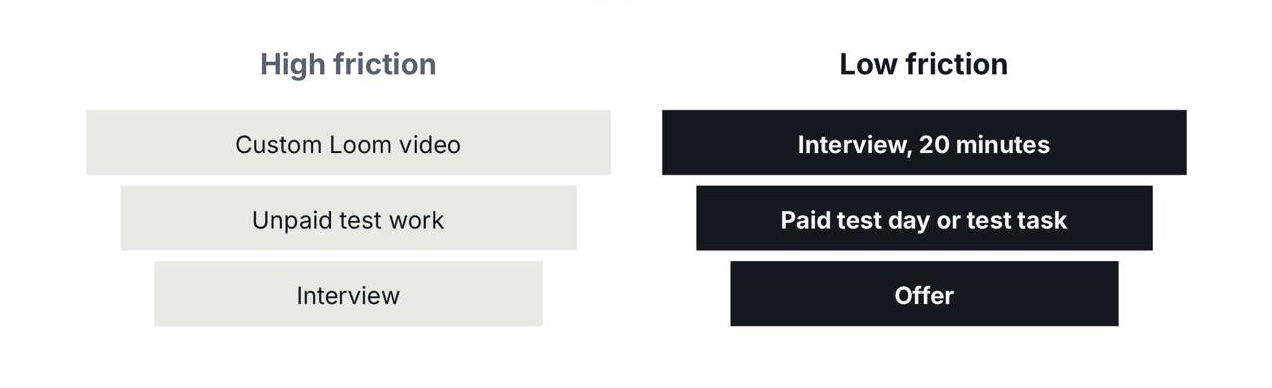
For marketing, developer, and C-level hires, keep the process short: a 20-minute interview, a paid test day or test task, then an offer. The test follows the same idea as the trial week. "For a marketer, that could mean showing them a creator they'd be responsible for, asking what they see and what's missing, and then giving them a concrete task." Perfection isn't the goal. "What you want to see is how they handle feedback. Tell them what you'd like done differently and watch how they react, how proactive they are, and how well they work with you on a solution."
Unpaid test work, on the other hand, drives strong candidates away. "Good candidates have options. Asking them to put in hours of unpaid work before they even know if they want the job is a lot. Always do the interview first. After a real interview, a small unpaid task can be okay."
As for speed, move "as fast as your process allows": reply quickly and get interviews booked. "Speed also says something about your company. You probably want people who move fast, and those are exactly the people who won't put up with a slow process." Artivate's own average time to hire is 7 to 21 days.
Speed applies to the process, not to the decision. "Waiting for someone who really fits is always better than hiring the wrong person quickly, and the more important the role, the more that matters."
Keeping Good People After the Hire
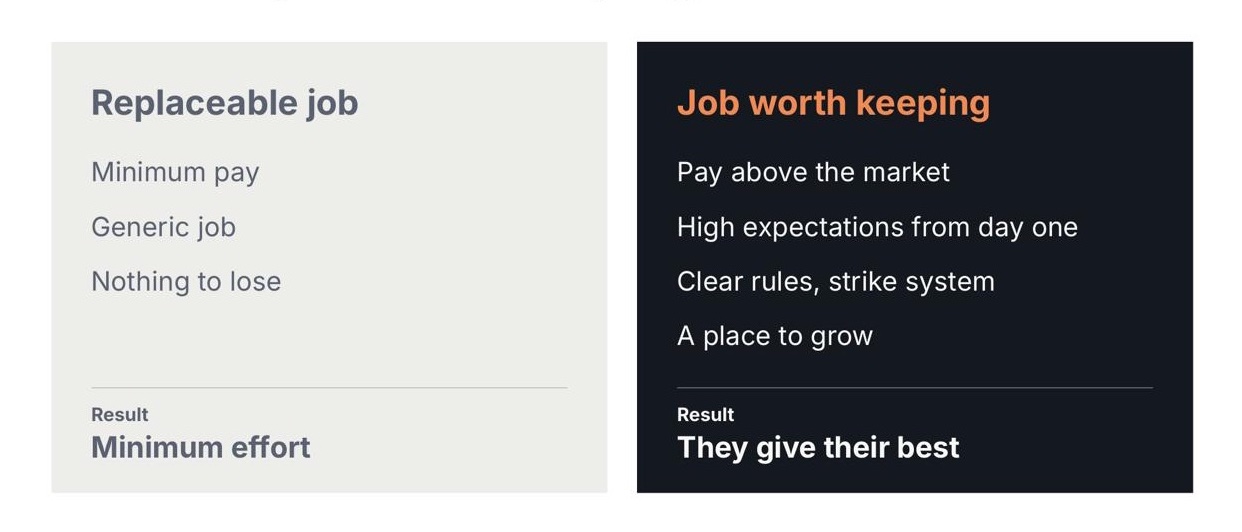
The goal is a job worth keeping. A replaceable job, with minimum pay, generic work, and nothing to lose, gets minimum effort. A job that pays above the market, sets high expectations from day one, has clear rules, and gives people a place to grow gets their best work.
Pay a little above market. Luis recommends "5 to 10% above the market average, measured on total monthly earnings and not on the commission rate." For chatters, real numbers do the convincing. "Tell candidates what your best chatters earn right now and what the average is."
Use a clear strike system for volume roles. A strike or warning system works well for chatters, while senior roles need a different approach. "Start by being clear about what you expect and just as clear about what's not allowed. Chatters have to follow certain rules, like the platform's terms of service, and one chatter breaking them can put the whole account at risk. For rules like that, a warning, then a final warning, then out works well."
Show a real growth path. "Make the path clear from the start, ideally with real examples from your own agency. Something like 'our chatting manager started as a regular chatter, did great work, and got promoted' motivates people more than anything you could promise.”
Growth doesn't have to mean management. "In bigger agencies, you can show what it took to get onto the prime shifts or the biggest accounts, and there are QA and other management roles too."
Reward the team together. "Set revenue goals and say upfront what everyone gets if the team breaks its monthly record."
Conclusion
Good hiring starts long before the job ad. Know exactly who you’re looking for, choose the market and channel that fit the role, be clear and upfront in every listing, hire for the skills your AI-assisted workflow actually needs, keep the process short and paid, and make the job worth keeping once people join.
Artivate places chatters, marketing talent, and senior hires for OnlyFans agencies, with an average time to hire of 7 to 21 days, a 6- to 8-week replacement guarantee depending on the contract, and a placement fee of 6 to 12% of the annual salary, paid only when you hire.