


.png)
For creators, choosing an agency can still mean navigating aggressive contracts, unclear expectations, privacy concerns, and hard-to-verify promises. Aruna Talent was built around a different idea: what if an agency designed its business around what puts a creator in a stronger long-term position?
Founded in 2022 by two operators who came from e-commerce and forex, Aruna entered the creator economy without being tied to the industry's existing way of doing things. From the outside, its founders saw an industry that often prioritized short-term revenue over creator ownership, security, and longevity.
“Aruna was built to prove it works better run the other way. Not as a moral position, as a commercial bet.”
Four years and more than 60 managed creators later, that idea still shapes how Aruna approaches everything from hiring and creator selection to privacy, contracts, technology, and offboarding.
Building the Agency Backwards
One of Aruna's first challenges was standing out in an industry where almost every agency seemed to make the same promises.
In 2022, creators were already surrounded by agencies promising growth, transparency, and support. From a website or sales call alone, it was difficult to know which claims would translate into the experience of working together.
Aruna's response was to focus less on making claims and more on building systems that could support them.
Over time, that meant staffing functions many agencies might consider overhead: content protection, messaging quality assurance, account security, identity separation, audience growth, and creator wellbeing.
These departments don't necessarily generate revenue directly. But for Aruna, that's not the point. The agency sees them as part of the infrastructure that keeps creators protected, supported, and willing to stay for the long term.
That focus on retention eventually became central to the business. Instead of asking only how much an account could earn this month, Aruna began asking what the creator would still have after months or years of working together.
What 300+ Creator Consultations Taught Aruna
One of Aruna's biggest changes came from something surprisingly simple: listening to its own calls.
The agency records consultations with consent for training and quality review. Once it had accumulated enough conversations, the team began analyzing them systematically instead of relying on assumptions about what creators cared about.
The results challenged one of the industry's most common beliefs.
After analyzing more than 300 consultations, Aruna found that privacy, family, and fear of recognition appeared in 91% of conversations. Contract terms and concerns about eventually leaving appeared in 87%.
Revenue split, one of the first things many agencies focus on, appeared in just 48%.
“The industry has spent a decade perfecting its answer to a question women aren't asking.”
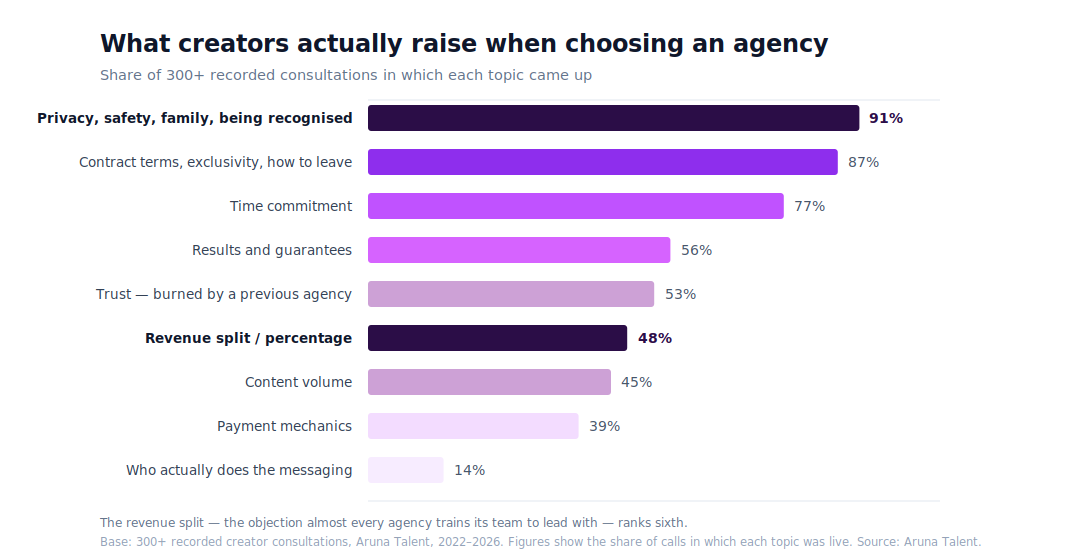
That discovery changed Aruna's consultation process. Today, a typical first call lasts around 30 minutes and focuses heavily on listening. Questions about privacy and about what happens if a creator wants to stop come early in the conversation, rather than being buried behind revenue projections.
It also changed how the agency approaches sales.
Aruna's acquisition team doesn't have the authority to sign a creator on the spot. They qualify the applicant, document the conversation, and the wider team decides whether the partnership makes sense.
The acquisition team is measured on the quality of its recommendations rather than simply the number of creators signed. Terms aren't individually negotiated either: Aruna says everyone is offered the same arrangement.
For the agency, the people deciding who joins should ultimately be accountable for whether the team can deliver for that creator.
Privacy Is Infrastructure, Not a Promise
The consultation data also reinforced something Aruna had already begun investing heavily in: privacy.
For many creators, the biggest concern isn't whether an account can grow. It's whether that growth can happen without exposing their legal identity to family, employers, or people in their everyday lives.
Aruna treats that as an operational problem rather than a reassurance given during a sales call.
Before a creator's first post goes live, the agency works on persona architecture, geo-blocking, account security, and identity separation. It also operates content protection and DMCA monitoring across more than 500 sites.
The goal is to think about exposure before it happens rather than only respond after something has leaked.
That approach extends to copyright takedowns. Aruna specifically avoids putting a creator's legal name into takedown filings, since information submitted through these processes can potentially become publicly accessible.
Across more than four years and 60+ managed creators, Aruna reports zero identity leaks.
It's the kind of work that doesn't necessarily show up on a revenue dashboard, but for an agency whose own data says privacy is one of creators' biggest concerns, it's a core part of what management is supposed to provide.
Who Aruna Is and Isn't Built For
Aruna no longer describes itself simply as a management company. Instead, it sees the relationship as a consulting partnership.
That distinction matters because the agency expects creators to remain active participants in their own growth.
The biggest quality Aruna looks for isn't an existing following, previous OnlyFans experience, or already-high revenue. It's conviction.
“We would rather back a woman with no following, no experience, and no advantages who intends to work than a promising one who's undecided.”
In fact, the majority of women applying to Aruna are either pre-revenue or earning under $5,000 per month.
What matters more is whether they're prepared to treat the work seriously.
Aruna considers the first 90 days particularly important. Ideally, creators put in around 30 hours during their first week, where their schedule allows, followed by roughly 20 hours per week afterward. According to the agency, the creators who front-load that early period are more likely to still be earning well two years later.
That selectivity also means Aruna says no.
Applicants already under contract with another agency are automatically declined. And if a creator's boundaries don't fit Aruna's model, the agency says it would rather refer her elsewhere than persuade her into an arrangement she isn't comfortable with.
The goal isn't to sign everyone who could potentially generate revenue. It's to build partnerships that both sides believe can actually last.
Building an Agency Creators Can Leave
Perhaps the clearest example of Aruna's philosophy is how it handles something most agencies would rather not focus on: leaving.
Either side can end the agreement with 30 days' written notice. According to Aruna, there is no exit fee or financial penalty for doing so.
When a creator leaves, administrative control of her OnlyFans account returns to her, along with her content and performance history. Subscribers remain with the account, meaning the audience and recurring income she spent time building don't disappear simply because the agency relationship ends.
Final earnings are settled, handles are rebranded, and infrastructure is handed back.
“Everything an agency believes about a creator shows up in how it behaves when she stops being profitable to it.”
Aruna says creators who previously left have even returned later with their accounts intact, something the agency sees as possible only when leaving isn't treated as a betrayal.
This is also why Aruna recommends creators ask about exit terms before getting caught up in commission percentages.
The split determines what you earn while you're with an agency. The exit determines what you still control when the relationship ends.
Technology Without Removing the Human
Behind the scenes, Aruna has grown into a distributed team of more than 100 people, supported by centralized communication, internal dashboards, and systems that keep creator information accessible across the team.
AI has become an important part of that infrastructure. Internally, Aruna uses it to analyze consultations and meetings, support content protection, qualify applications, automate financial reporting, and power internal tools.
On the fan-facing side, the approach is more deliberate. Documented voice standards and quality assurance help keep each creator's messaging consistent across chatters and shifts. AI supports the team by reducing repetitive work, surfacing important fans, and maintaining consistency rather than replacing human judgment.
For agencies building a similar system, Aruna points to Supercreator as a way to support that workflow. Supercreator combines AI-assisted chatting and creator-approved customization with a CRM, inbox, automations, follow-ups, and mass messaging tools designed for creator teams.
For Aruna, AI works best as leverage for a well-trained team, not as a substitute for one.
Success Isn't Just What a Creator Earns
Another part of Aruna's model starts after the money comes in.
Creators entering the industry may suddenly find themselves earning significantly more than they have before, often without an employer withholding taxes or providing the financial structure that comes with traditional employment.
Making money and keeping it are two different skills.
That's why Aruna includes financial education around taxes, bookkeeping, what creators should set aside, and how they can think about the money they're earning beyond their next payout.
The agency also brings in outside confidence and mindset coaching to support creators with the psychological side of working in an industry that still carries significant stigma.
For Aruna, a successful creator isn't simply someone who has a strong month.
The longer-term goal is for her to leave the experience with something durable: money, financial knowledge, an audience, confidence, or a business she still controls, whether she's still creating content three years from now or not.
Where Creator Management Goes Next
Aruna expects AI to reshape the creator economy, but not necessarily by replacing everyone currently doing the work.
Instead, the agency expects chatting to become increasingly automated. Routine and mechanical tasks can be handled by technology, allowing trained teams to spend more time on conversations, decisions, and fans that actually require human judgment.
At the same time, that creates a bigger challenge for agencies.
If AI makes competent basic execution inexpensive, simply offering to post content and reply to fans won't be enough to justify a management fee.
The things that become more valuable are the ones that are harder to automate: judgment, protection, relationships, strategy, and accountability when something goes wrong.
Aruna also expects synthetic performers to become a meaningful part of the creator economy and sees diversification beyond a single platform as increasingly important.
But one of the trends the team is most optimistic about is the professionalization of creator management itself.
More agencies are developing real quality assurance, training, financial controls, security processes, and operational standards. At the same time, creators are becoming better informed about what they should expect from the businesses representing them.
That makes it harder to compete on promises alone.
What Creators Should Ask Before Signing With an Agency
For creators considering management, Aruna's first piece of advice is simple:
“Ask about the exit first, not the split.”
Before discussing percentages, ask what happens on the day you want to leave. How much notice is required? Is there an exit fee? Who controls the account? What happens to your content, subscribers, data, and earnings?
Then ask the agency what it turns down. Any agency can explain who it wants to sign. An agency with clear standards should also be able to explain who it won't sign and why.
Ask who actually messages your fans and whether the agency gives you a straightforward answer.
Ask specifically how your identity is protected, not simply whether the agency “takes privacy seriously,” but what systems are actually in place.
And be skeptical of guaranteed earnings. An agency can provide strategy, infrastructure, traffic, messaging, and expertise, but the creator herself remains one of the biggest variables in the result.
Final Thoughts
Aruna Talent’s creator-first approach goes beyond positioning. It shows up in how the agency measures creator concerns, invests in privacy and well-being, chooses who it works with, and handles the end of a partnership.
The philosophy is simple: measure what you claim and build systems that prove it.
For creators considering working with an agency, Aruna encourages asking the hard questions upfront — about privacy, contracts, expectations, and what happens if you leave.
In practice, Aruna Talent is a creator consulting partnership founded in 2022, working with a women-only roster on OnlyFans and adjacent platforms. The agency staffs identity protection, content takedowns, messaging quality assurance, and creator wellbeing as internal functions.
If you’re weighing your options, you can apply to Aruna Talent for a 30-minute, no-pressure conversation and honest numbers, whether or not the agency is the right fit.




.png)

